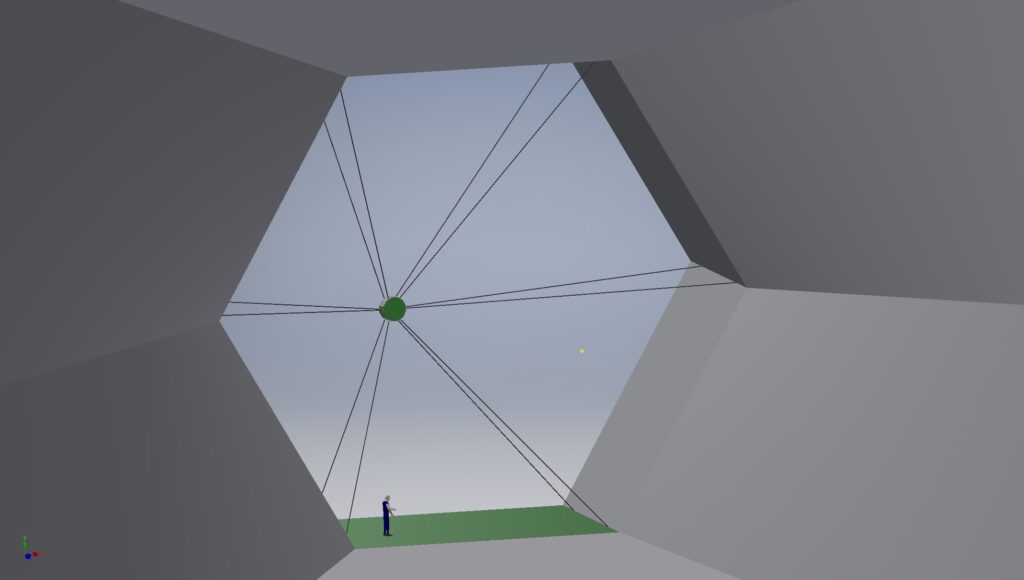
UK and International Patents have been applied for a high dynamic target motion system based on Cable Driven Parallel Robot (CDPR) principles.
Existing target motion system are typically based on some form of mechanical track arrangement to provide azimuth and elevation motion which invariably involve an expensive dynamic gantry and support structure. Their overall performance is constrained by the tracking system, which relies on various rollers, runners, and wheels—all of which have inherent speed and acceleration limits. Simply increasing the motor power does not overcome these limitations and can, in fact, make matters worse by adding weight to the moving system. This added mass increases the dynamic load, leading to a cycle of diminishing returns. The challenge becomes even more pronounced as performance is considered in angular terms: as the radius of motion increases, the linear speed and acceleration of the tracking system must also increase proportionally to maintain the same angular velocity and acceleration. Eventually, the system reaches a point where improvements in performance are no longer possible—and in some cases, increasing the radius actually leads to a decrease in angular performance.
By relocating the motive components, in this case winches, to the extremities, the mass to be accelerated is significantly reduced. The winches are not operating near their limitations and can be configured for different speeds and accelerations. The result is a target motion profile high in angular acceleration and velocities. The image above is a simple arrangement to show the principle. There are infinite arrangements to accommodate varying end user requirements some of which differ from this example but maintain the principle of a lightweight target articulated by remote drive units.
The international patent application can be viewed at : https://patentscope.wipo.int/search/en/detail.jsf?docId=WO2022129904&_cid=P11-LOFMCU-02008-1.
The European Patent was published in the European Patent Bulletin on 25 October 2023 under Publication No. 4264315